
Val d'Isere for a Short Ski Break: five reasons why a 3 or 4 night break actually makes sense
Tucked away high up in the Tarentaise Valley, officially an area with the highest concentration of world-class ski resorts anywhere in the world, sits the ancient town of Val d'Isère. Its church was completed in 1664, perhaps the builders celebrated its opening with the brand new beer brand from Strasbourg, now known as Kronenburg. Before the church, evidence of Celtic settlements have been found here, and it's a well-documented hunting base for the Dukes of Savoy (1416-1860).
By the 1930's, skiing had found its way to the remote high-alpine glacial valley with the first drag lift. It's a wonder anyone found the place, the remoteness is about as extreme as it gets in the Alps, perched up against the border of Italy, with the highest paved mountain pass in the Alps, the Col de L'Iseran, connecting Val d'Isere with the Maurienne Valley.
It's a wonder the Celts managed to find the place, let alone live in what is officially a sub-Arctic climate with an annual average temperature of 3.8 degrees centigrade.
That climate and its location has over the past 30 to 40 years, helped to contribute towards what is now considered to be one the best ski resorts in the world, with a large interconnected lift system that includes neighbouring Tignes. Once known as L'Espace Killy, after one of Val d'Isère's residents, Jean-Claude Killy, the Tignes-Val d'Isere area has around 300km's of piste suitable for all ski and snowboard levels, but is popular with advanced and experts as it offers a huge amount of steeper and off-piste terrain.
Fortunately today, the road from the region's capital town, Bourg St Maurice, is well maintained and before the 1992 Winter Olympic Games in nearby Albertville, the road infrastructure had major upgrades, cutting journey times from Geneva and Lyon into the Tarentaise and further up towards Val d'Isère,
And whilst it might have not been a first choice destination for a short break all those years ago, there's a number of reasons why now, it makes perfect sense to travel just that little bit further to reach what might be the best tasting fruit on the tree.

Let's look at five reasons why with some planning and help from SkiWeekends, this is the case.
1. Regular transfer times from Geneva Airport
Geneva has established itself as the major hub airport for the North Western Alps (Northern French Alps and Tarentaise and the Vaud and Valais regions of Switzerland). Twenty years ago, trying to find a way to get from an airport Lyon or Geneva to Val d'Isere felt harder than getting down the legendary Face piste, watered down and iced up for the men's world cup downhill races. Renting a car was the only option, unless you wanted to wait three days for a public bus with two changes in the middle of nowhere. Today, there's a highly organised and regulated transfer service that runs people carrier style vehicles, with pre-booked shared transfers from Geneva arrivals. Even better, the transfers are included in SkiWeekends chalet holidays. The journey takes around three hours, which in normal traffic, is longer than some resorts such as Les Gets or even Avoriaz – but, and here's the key question, does it mean less skiing on a short break because of that time difference? The answer, in the words of Val d'Isère resident snow safety expert Henry Schniewind, depends on you. Plan your flight times well and there's no reason that with a three night stay, you can't get three days skiing in - and with a four night stay, you can't get four days skiing in. That's just four nights with four days skiing, instead of seven nights and six days skiing.
2. World Class resort experience without the huge price commitment of a 7 night stay
let's be honest, a resort like Val d'Isère doesn't come cheap. It's a premium destination and prices can reflect that, both in town and on the mountain. But it's the kind of bucket list destination that many skiers and snowboarders have on their list and one of the barriers is cost. Booking a 3 or 4 night stay with SkiWeekends means mitigating that to a certain extent, but I hear you saying, ‘of course it does you're staying for less time'. That's the obvious part, but they key point is the opportunity to experience somewhere like that without that full commitment, staying in well-located SkiWeekends chalets that offer catered accommodation and packed lunch options, saving further cash on what could easily become a very expensive holiday. I'm going to call this the SW factor – nope, not SkiWeekends, but SavingWodge.
3. Reliable snow conditions that won't let you down
you're wanting to get the most out of this holiday, make sure the snow is the best you can get. There's lots of arguments around snow records across the Alps and altitude isn't always the number one factor in guaranteeing good snow conditions. However, in the case of Val d'Isere, the combination of altitude and location means that the resort falls into some of the top average snow depths in the Alps, along with the likes of Avoriaz (France) and Lech-Zurs (Austria). The village itself sits at 1800 metres above sea level and the ski area rises to above 3,000 metres – rain is extremely rare during winter months at village level and that means snow conditions remain excellent from early December through the winter and often well into spring. It is one of the best places to ski during April.
4. Something for every skier or snowboarder
if you have to pick a ski resort for a group of people then Val d'Isère is an easy choice. Val d'Isere is synonymous with expert level ski terrain, with legendary pistes such as the Face de Bellevarde or off-piste routes like the Tour de Charvet or Col Pers, but what many forget is the excellent beginner's terrain in the village itself, let alone the vast expanse of marked intermediate slopes available too. Ski resorts can't survive on expert terrain only (okay, La Grave just about does), and whilst it makes great headlines, the real truth is in what lies behind them. Then there's the après, again, something for everyone including the original La Folie Douce, with its vast outdoor terrace above La Daille that kicks off early afternoon – think Rio Carnival style on snow, to live rock music with your favourite tunes at Cocorico's (practically a snowball's thrown away from the SkiWeekends chalets) where every afternoon a live band plays before dinner time. Or maybe it's a quieter beer at La Rossee Blanch after a run down to La Daille or perhaps some late night partying in Le Petit Danois.
5. Bragging rights
okay this is really crass but let's just be honest, all your friends will be impressed that you have skied here and you don't even need to tell them about the fantastic blue runs that are available. Let's have a look at the breakdown of graded runs in Val d'Isere, it tells you the truth behind the headlines: Green (very easy), 21, Blue (easy), 65, Red (intermediate), 41 and Black (difficult) 32. That is over 50% of the whole ski area graded as easy. Just don't tell your friends.
A short break in Val d'Isere is also relatively easy compared to other destinations in the Alps. Yes, the transfer might be a little longer, but what you find when you get there might not quite be forbidden, but it's certainly worth leaving some of the low hanging fruit behind to explore the delights of what is higher above. Cheesy? Yes perhaps, but you tell me I'm wrong and I'll happily eat my Reblochon – another reason to travel to the Tarentaise!
Val d'Isère short breaks: the practical guide - The ski area at a glance
Location: Tarentaise Valley, Savoie, French Alps
Village altitude: Approximately 1,850 metres
Linked ski area Tignes–Val d'Isère, formerly known as Espace Killy
Total piste length: Around 300 kilometres across the linked area
Skiing altitude approximately: 1,550–3,400 metres across the linked area
Main Val d'Isère sectors: Bellevarde, Solaise and Le Fornet/Pisaillas
Glaciers: Pisaillas in Val d'Isère; Grande Motte in Tignes
Planned winter season: 28 November 2026–2 May 2027, subject to conditions
Figures refer to the combined Tignes–Val d'Isère area unless stated otherwise. Not all terrain will necessarily be open throughout the season.
Where to ski
Solaise: Dedicated learning areas and accessible terrain for building confidence. A useful starting point for beginners and groups finding their ski legs.
Bellevarde: Varied pistes, the famous Face de Bellevarde and access towards Tignes. Plan your route around your ability; the Face is a challenging descent.
Le Fornet/Pisaillas: High-altitude skiing at the eastern end of the resort. Check lift openings before committing to a trip across the area.
Tignes: A substantial extension to your skiing when using the linked-area pass. Leave plenty of time to return before connecting lifts close.
Beginners and progressing skiers can use designated easy-skiing areas on both Solaise and Bellevarde. You don't have to tackle the headline black runs to enjoy Val d'Isère.
Getting there from the UK
By air: Geneva Airport
- Road transfer: allow approximately three to four hours, with longer journeys possible in heavy snow or peak traffic.
- SkiWeekends chalet holidays: shared return Geneva Airport transfers are included; flights are booked separately.
- Before booking flights: confirm the transfer arrangements for your chosen arrival and departure times.
- To maximise skiing: look for an early outbound flight and a late return, then check how much slope time the actual transfer schedule permits.
Alternative airports
Lyon and Chambery are also options. Compare flight availability, transfer cost and the complete journey before booking: a closer airport is only useful if its flights and onward transport suit your dates. The resort lists direct bus connections from Geneva and Lyon; check the operating days and timetable for your trip.
By train
UK to France: Eurostar from London St Pancras, with onward connections according to your chosen service
French rail journey: Travel to Bourg-Saint-Maurice, the nearest railway station
Final transfer: Pre-booked bus or taxi to Val d'Isère; allow approximately 40–60 minutes, depending on service and conditions
By road
Approach via Albertville > Moûtiers > Bourg-Saint-Maurice > D902 to Val d'Isère. Book parking ahead and check road conditions before the final climb.
Route warning: the Col de l'Iseran is closed in winter. Don't plan to reach Val d'Isère from the Maurienne Valley over the pass, even if that route appears attractive on a map.
Staying with SkiWeekends
4 ski-in/ski-out catered chalets
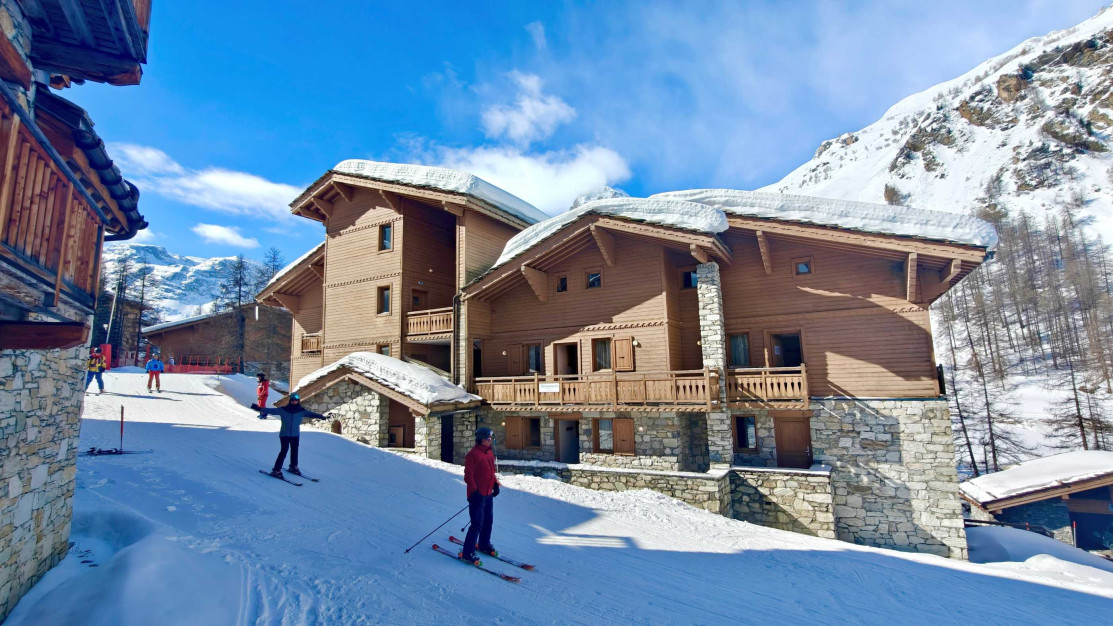
Chalet location: La Legettaz, beside the red Santons piste
Distance to town centre: Approximately 700 metres
Accommodation options: Book individual rooms or a whole chalet for your group
Arrival/departure facilities: Bag storage helps guests ski before room check-in and after check-out
Extras to arrange: Flights, lift passes, equipment rental and lessons
Check the catering schedule for your dates, including any staff night off, and confirm packed-lunch arrangements when booking.
Access tip: ski-in/ski-out describes the location, but the return piste still needs to suit your ability. Less confident skiers should ask about alternative routes back.
Two mountain restaurants for good value
Mountain lunches needn't mean a long, expensive sit-down affair. Les Marmottes and La Cascade are particularly good options for value, with both attracting positive feedback for reasonably priced mountain meals.
Six ways to make the most of your stay
- Reserve equipment ahead. Ask about arrival-evening collection so your first full morning starts on the slopes.
- Book lessons that fit your dates. Check that group courses accept short-stay guests; private tuition offers another option.
- Choose the right pass. Compare Val d'Isère and linked-area options against your ability and intended itinerary.
- Check live lift information each morning. Weather may influence which sector makes most sense that day.
- Set a turnaround time for Tignes. Leave a comfortable margin for getting back across the link.
- Keep departure day organised. Allow time to return skis, change and collect luggage before your transfer arrives.